
Hospitality rebrand work for a Gqeberha finisher
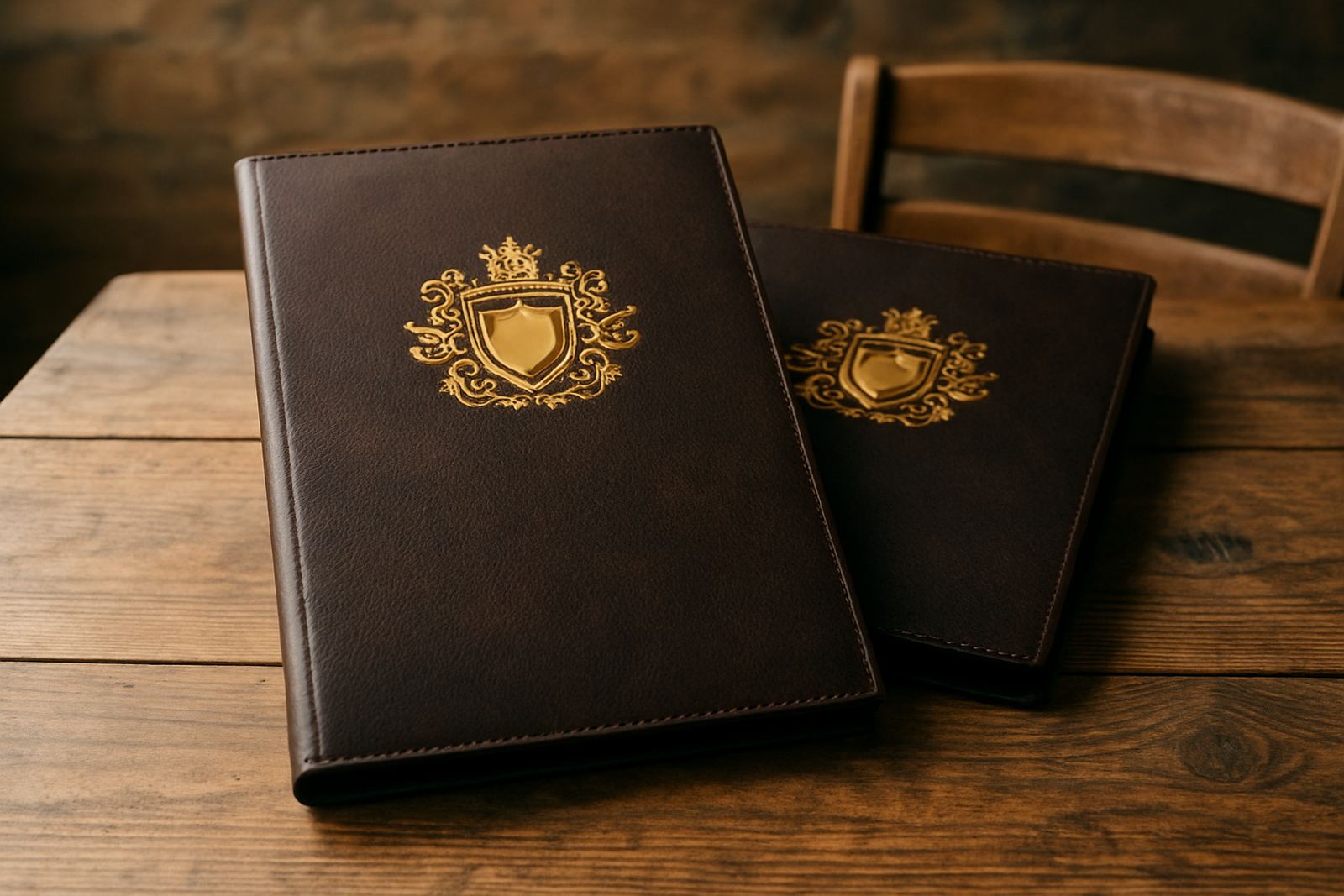
This job came from a cover finishing team in Gqeberha handling a refresh for a hospitality group with menus, wine lists and presentation covers across several locations. The client needed crest dies that would hold detail on short runs and repeat orders, while still looking clean on textured cover boards and coated stock. The work had to suit a busy finishing floor where changeovers happen quickly and the same tool may be used again months later.
The brief was straightforward on paper but exacting in practice. The crest had fine linework, a ring of small lettering, and a solid outer border that needed to strike evenly without bruising the stock. Because the covers were going out to different outlets, the finisher also wanted tooling that would be easy to set up on a hot press and simple to store for repeat use. We treated it as a production job, not just an artwork file, so the tool spec, mounting detail and dispatch notes were all part of the order.
What the brief asked for
The customer was clear about the result they wanted: a crisp crest, consistent impression depth, and clean registration when the foil and emboss were combined. They also needed guidance on what would work best for a hospitality application, because menu covers get handled often and can pick up wear faster than a one-off presentation item. In coastal conditions like Gqeberha, humidity can also affect boards, adhesives and set-up consistency, so we factored that into the advice we gave.
- Tool type: brass hot-stamping die for the main crest and magnesium die where lighter duty repeat work was suitable
- Finish: foil stamp with optional embossing plate for counterforce matching
- Artwork: supplied as a detailed crest with small text and border elements
- Use case: menu covers for a hospitality rebrand
- Delivery: couriered to Gqeberha for the finisher's production schedule
There was also a practical constraint around turnaround. The client wanted the first run ready in time for a seasonal launch, so we had to move from artwork check to engraving without delays. That meant confirming the line weights, spacing, and the smallest readable details before cutting began. A good die saves time later, and a bad one creates wasted sheets, rework and extra heat on the press.
Artwork checks and die planning
Our prepress review started with the artwork file and a discussion around the cover material, foil colour and press method. Megan Petersen checked the image elements for line thickness, spacing and any areas likely to lose clarity at production size. We also looked at where the crest would sit on the menu cover so the tool could be centred properly and still allow for trimming tolerances after binding. It is a simple step, but it avoids a lot of grief later on.
For the crest, Johan van der Merwe planned the engraving sequence so the small lettering and border could retain sharp edges. Ayesha Naidoo then matched the die approach to the expected production volume, balancing durability with speed of manufacture. Where the finisher needed a stronger impression on thicker board, we advised on counterforce matching so the emboss would sit cleanly without over crushing the surface. That kind of adjustment matters when the same menu cover has to look presentable from the first unit to the last.
- Artwork size confirmed before engraving
- Fine detail tested for readability at finished scale
- Counterforce reviewed against the cover stock
- Repeat order notes filed for future reprints
Engraving, counterforce and dispatch
Once the artwork was approved, production moved into engraving and plate preparation at our Industria base in Johannesburg. The brass die was made for the main crest where detail retention and long service life were important, while the magnesium option was prepared for lighter, faster handling where required. Both were finished with the same care because the customer wanted no visual difference between runs. The packing also had to be practical, because tools travel well only if they are wrapped and labelled properly.
We included clear job filing for the order, sample impression advice and packing dispatch notes so the finisher could get onto press quickly on arrival. Sibusiso Dlamini coordinated the courier movement from Johannesburg to Gqeberha and kept the job tied to the production date. The total lead time from confirmed artwork to dispatch was two weeks, which gave the client enough room to slot the dies into their own schedule without having to reshuffle other finishing work.
- Production completed at Industria, Johannesburg
- Couriered nationwide to Gqeberha
- Total turnaround: 2 weeks from approval to dispatch
- Job filing kept for repeat ordering and future alterations
How the dies performed on press
On the first run, the finisher reported clean crest definition and even pressure across the full design area. The lettering held properly and the outer border did not break down at the corners, which is often where shallow tooling shows its weakness. The emboss response was also steady on the selected cover stock, with no unwanted sinking or drag marks. That gave the hospitality client a consistent look across the menu sets, which is what they needed for front-of-house presentation.
There was one practical win that mattered just as much as appearance. Because the dies were set up with the right depth and counterforce from the start, the press team did not need to spend extra time testing and adjusting every sheet. That helped them keep pace with the rebrand schedule and get the covers out without fuss. In a busy finishing room, less fiddling means less waste and better margins. It also makes repeat production easier the next time the client calls back.
What we would repeat on the next run
If this same Gqeberha job came in again, we would handle it the same way. Start with the artwork check, confirm the cover stock and intended foil finish, then set the tool around the smallest readable details before anything goes to engraving. For hospitality work, that first planning step matters because menus are handled, wiped and changed often, so the tooling has to look good and survive ongoing use. We would also keep the job file active for a quick repeat order and note any alteration requests if the client changed the crest or cover format later.
For a finisher working under deadline, the most useful part of the process is knowing that the die will arrive ready to use, with the counterforce and impression advice already matched to the job. That is what the client got here, along with practical support from our team in Johannesburg and clear dispatch to the Eastern Cape. It is the sort of order that runs better when the small details are handled properly from the start.
- Repeat the same artwork verification before reordering
- Keep the die notes on file for future hotel or restaurant rollouts
- Review wear and cleaning needs after each production batch
- Allow for municipal and venue timing if the covers are tied to a launch event
Key facts
| Project | Menu cover crest dies for hospitality rebrand |
|---|---|
| Client type | Cover finisher supplying hospitality menus and presentation covers |
| Town | Gqeberha |
| Tooling supplied | Brass hot-stamping die, magnesium die, embossing plate support |
| Turnaround | 2 weeks from approved artwork to dispatch |
| Base and dispatch | Industria, Johannesburg with courier delivery nationwide |